inQntrol Platform
To gather objective feedback and minimize bias, general public can submit safety reviews by answering fact-based questions covering the five safety dimensions. Additionally, for dedicated Google Maps Local Guides, question cards are prompted while they are at the location, minimizing the effort required to recall current safety conditions.
Increasing troubleshooting confidence in facilities management
Making safety information reliable and accessible on Google Maps
inQntrol Platform
Increasing troubleshooting confidence in facilities management
My role:
Product designer
Contributed to the desktop design, spearheaded the design and usability testing sessions for the mobile flow, and supercharged UI visual consistency
Time frame:
Sep–Dec, 2022
Skills:
Contextual inquiry, Prototyping, Concept testing, Research through design, Design System
Team:
1 UX researcher, 2 product designers, 1 engineer, 1 PM

Gaining control over reliable sensor data is crucial in facilities management for ensuring the safety and comfort of the space. inQ Services is a SaaS IIoT startup that monitors the well-being of facility devices and reduces costly equipment downtime.
I worked with a team to uncover product-market fit, designing a new set of features for inQ's flagship product, inQntrol, a platform that enhances troubleshooting confidence in facilities management by providing spatial data for sensor alerts. Employing a human-centered approach to address the challenges of a hardware-centered industry, the new solution helped inQ establish a key value proposition and contributed to securing a contract with the US government, paving the way for an upcoming beta launch next year.
My role:
Product designer;
Contributed to the desktop design, spearheaded the design and usability testing sessions for the mobile flow, and supercharged UI visual consistency
Time frame:
Jan–Aug, 2023
Skills:
Contextual inquiry
Prototyping
Concept testing
Research through design
Design System
Team:
1 UX researcher
2 product designers
1 engineer
1 PM
Goal
How might we make troubleshooting in facilities management more efficient?
Problem
Troubleshooting in facilities management feels like a guessing game

1️⃣
Facilities managers experience alert fatigue, they have to spend extra hours extracting the relevant alerts from the system

2️⃣
They struggle with managing alerts as they need to switch between multiple software applications

3️⃣
They are uncertain of the underlying causes behind a problem due to the lack of a clear oversight
Solution
Who is this solution for?
Facilities management stakeholders
.png)
inQntrol is a facilities management tool that provides spatial understanding for in-person and online troubleshooting, reducing alert fatigue and operational inefficiency experienced by users.
GOAL
To provide travel safety information that is relevant, trustworthy, and digestible to female solo travelers
Outcome
A new safety layer on Google Maps that provide aggregated safety information about neighborhoods
LOCALITY
SafeZone is a geographical representation of safety. It maps “safety scores” of cities and neighborhoods based on government published data and crowdsourced, user-submitted reviews.

DECISION MAKING
Assess safety across five key dimensions: public transit, crime rate, phone signal, busyness, and walking at night. The scoring system relies on publicly available data and user-reported community information to maintain objectivity. Users can compare safety scores of different neighborhoods, enabling faster decision-making regarding safety.

CONTEXTUAL ASSESSMENT
Utilize crowd-sourced information to make a comprehensive assessment based on personal situations. Users have more flexibility to filter reviews based on identities and personal concerns that matter to them the most

To gather objective feedback and minimize bias, general public can submit safety reviews by answering fact-based questions covering the five safety dimensions. Additionally, for dedicated Google Maps Local Guides, question cards are prompted while they are at the location, minimizing the effort required to recall current safety conditions.
COMMUNITY


To gather objective feedback and minimize bias, general public can submit safety reviews by answering fact-based questions covering the five safety dimensions. Additionally, for dedicated Google Maps Local Guides, question cards are prompted while they are at the location, minimizing the effort required to recall current safety conditions.
PROBLEM
Female solo travelers face challenges when seeking safety information for their travel planning. The existing resources are scattered and fragmented, making it time-consuming and arduous to gather comprehensive and personalized information that caters specifically to their needs.
Discovery
Safety concerns influence how people plan for traveling
DESKTOP RESEARCH | USER INTERVIEW | DATA ANALYSIS
Design System
Maintaining consistency with Google Maps design system

In the beginning of the project, we didn’t have specific target audience to design for in travel planning. After conducting extensive research on social media, travel websites, research papers, and interviews to gather data on travel planning, we identified a prevalent issue: safety concerns. Recognizing the significance of this problem, we chose to narrow our focus to female travelers, considering their general vulnerability and the emerging opportunities within this group.

Travel Planning

How might we help women in mitigating safety concerns when planning their travel experiences
I created the prototype for the Augmented Reality view for accessing sensor status. Users were the most excited about this feature, seeing a rise in new hire's troubleshooting confidence by 70%
I led the mobile design which facilitated faster access to locations of alert root causes on-site. 8/10 users believed that using the mobile mechanical floor plan with device status will help reduce machine downtime
Connecting sensor data from all legacy platforms in one place, facilities managers can gain a holistic view of data relationships in different locations.


A directory for consolidating different sensor sources
With sensor alerts now organized by zones rather than a list format, facilities managers can prioritize critical and relevant alerts.
I designed the alert description panel, which allows users to create actionable work orders, and this resulted in a 33% increase in user confidence for faster alert resolution
Desktop Features:
A map designed to facilitate actionable alerts

Locating hidden device and access real-time data via AR
App Features:
Remote access to resources for locating alerts on-site
Research At A Glance
How do female travelers assess risks of a destination?
Defining Problem
How did we tap into the human needs in the highly technical domain of facilities management?
Initially, we encountered a highly technical challenge and struggled to find a break through point for inQ to establish their first customer base, yet after intensive user research, we identified 3 key insights focusing on why troubleshooting in facilities management is not efficient currently:

01. Alert fatigue
Facilities management receives overwhelming numbers of low-quality alerts daily, many unrelated to their direct responsibilities

02. Lack of holistic view
The need to jump back and forth between different systems in order to diagnose a problem increase troubleshooting time

03. Man power shortage
It's costly to onboard new staff who don't come with years of experience or unfamiliar with campus space
.png)
.png)
Measuring Success
Assessing metrics for inQntrol's beta launch
Unpacking User Needs & Ideation
Turning insights into design ideas on providing actionable data
I led the team in conducting a "5 Whys" activity, delving into underlying user needs by repeatedly asking "why" to uncover the root cause. This paved the direction for the idea brainstorm and from 24 sketches, we refined our focus to three promising ideas, validated through low-fidelity testings:

⓵ Grouping alerts based on relevance and criticality to reduce alert fatigue
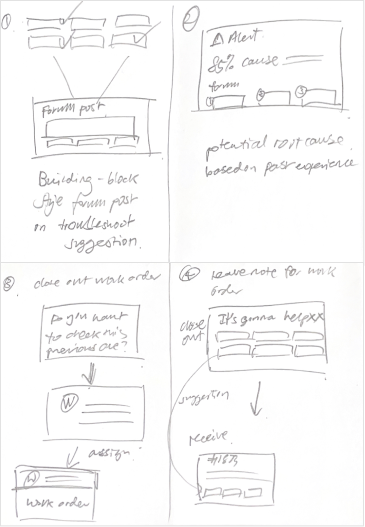
⓶ Leverage past experiences from others to generate problem root causes

⓷ Using geo-guidance to locate sensors and check their status in the space
Concept Testings
Key discoveries uncovered value proposition
We consulted the technical feasibility of tagging devices in space by engaging with an Apple Vision Pro AR engineer, and tested the product's desirability and usability with facilities management. The prototype has received overwhelmingly positive feedback from both the users and clients.


⤵️
8/8 users agree on reduced onboarding time, easing the industry manpower shortage
📈
Users reported an increase in their confidence in troubleshooting by 25%
Metrics to collect for beta launch
We handed off the design assets to the development team, to ensure the success of inQntrol beta launch, here are some metrics we hope to measure:
💸 reduced training cost for new hire, less shadowing from current staff
👍 increased occupant (individuals who made public service requests) satisfaction rate due to efficient resolution
⏱️ reduced travel time between facility management office and problem site
💵 reduced operational cost over a quarter
Learning: Build-test-iterate feedback loop
This experience has taught me the power of "showing" rather than just "telling," especially within a lean startup context when the value proposition wasn't initially clear. We shared early concept prototypes with users in the beginning of our research, which helped revealing hidden users needs that interviews alone couldn't uncover. Looking back, I would prioritize setting clear objectives early on. During instances of analysis paralysis, I would stand firm on final decisions and let real users validate them.
Prototyping
Gathering user feedback and iterating design
%201.png)
Usability testing and design iterations
I focused on the mobile flow, which starts from when a work odered is created from an alert and assigned to a technician, and they troubleshoot from there. Some majors changes I made along the way include:
-
Focus more on providing resources to assist users in solution discovery as opposed to giving detailed instructions
-
Simplify the process for users to access the floor plan where the problem occurs from receiving a work order
-
Reduce visual clusters and increase visual hierarchy of UI
-
Making content more closely resemble real-world troubleshooting data


I created a workflow to identify opportunities for enhancing facilities management processes:
1. Enhance awareness and comprehension of problem root causes during virtual troubleshooting
2. Facilitate action during on-site troubleshooting


“The ability to be able to aggregate sensor information is so difficult since you have to monitor so many different systems”
--Facilities manager at Carnegie Mellon University
.png)
.png)
.png)
I led 19 out of 43 concept testing with stakeholders on alert grouping and root cause suggestions. The goal is to uncover the desirability of these ideas in reducing alert fatigue as well as reducing troubleshooting time. Turned out we uncovered some surprising findings about users' mental models which led to the discovery of the value proposition for inQ.

❌ Lack of trust in AI-based smart alert grouping to predict cost savings, risk reduction, and time savings accurately

❌ Implementation costs for establishing a new documentation system for sensor nomenclature are too high

✅ Users appreciate the clear categorization of alerts that help with sorting priority tasks. Accessing them via mobile also promotes quick actions.
%201.png)
✅ Leveraging crowd-sourced insights, the system predicts causes and recommends actions based on past data and forum input, a significant time-saver.
Value proposition discovery
During concept testing, we realized users are already using a platform called Maximo to receive alerts, which led to the question--how do we introduce the value of inQ to users more than just being an alert manager? We went back to shadowing more users and doing more competitive analysis, our discoveries led to a key opportunity for inQ to fit in the market gap:

High-fi design
Tying mobile and desktop apps together
.png)
Our team worked separately on designing desktop and mobile screens to cater to our two user groups' different needs and tasks (facilities managers and technicians). To ensure the design tells a cohesive narrative, I took the lead in building a style guide and refining the UI for visual and interaction consistency
